
Dikeye Yakın Rotorlar
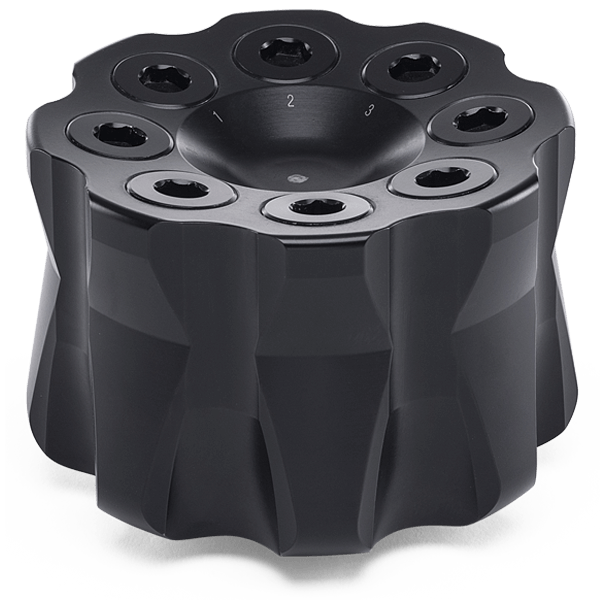
Dikeye yakın rotorlar kısa yol uzunluğu, hızlı çalışma süresi ve mükemmel çözünürlük özelliklerine sahiptir.
Dikeye yakın tüpler dik açıya göre hafifçe, 7,5°– 9° arasında eğimlidir. Bu, izolasyonun gerçekleşmesi için daha kısa bir yol oluşturur. Daha kısa yol, daha kısa bir ayırma süresi anlamına gelir.
Hafif açı peleti tüpün tabanına doğru iter, böylece çalışma durduğunda solüsyonlar pelet haline gelmiş kontaminantlarla temas etmez.
Yeni Intellifuge Calculator’u [Hesaplayıcı] çalışırken görmek için buraya tıklayın.




FAQ on Near-Vertical Rotors
What is the difference between a near-vertical rotor and a fixed-angle rotor?
A fixed-angle rotor is typically optimized for rapid pelleting applications, while a near-vertical rotor is often chosen for density gradient and isopycnic centrifugation workflows. Near-vertical rotors provide a shorter path length within the gradient, which can help reduce separation times for equilibrium and gradient-based applications.
Why are near-vertical rotors used for density gradient centrifugation?
Near-vertical rotors provide a shorter sedimentation path than many other rotor designs. This can reduce run times and support efficient density gradient separations while maintaining resolution between particles with different buoyant densities.
Why choose a near-vertical rotor for DNA purification?
Near-vertical rotors are commonly used in density gradient-based nucleic acid separation workflows because they can support efficient migration of DNA molecules through the gradient while reducing run times compared with some traditional rotor configurations.
What is a near-vertical rotor?
A near-vertical rotor is an ultracentrifuge rotor that holds sample tubes at a shallow angle between vertical and fixed-angle orientations. This geometry creates a shorter sedimentation path, helping reduce centrifugation times while maintaining high separation efficiency.
What applications are near-vertical rotors commonly used for?
Near-vertical rotors are frequently used for density gradient centrifugation, isopycnic separations, DNA purification, viral particle isolation, lipoprotein analysis, and other high-resolution ultracentrifugation workflows.
What is isopycnic centrifugation?
Isopycnic centrifugation is a density gradient separation technique in which particles migrate until they reach a position where their density matches the density of the surrounding gradient medium. Near-vertical rotors are commonly used for these applications because they can support efficient equilibrium separations.
